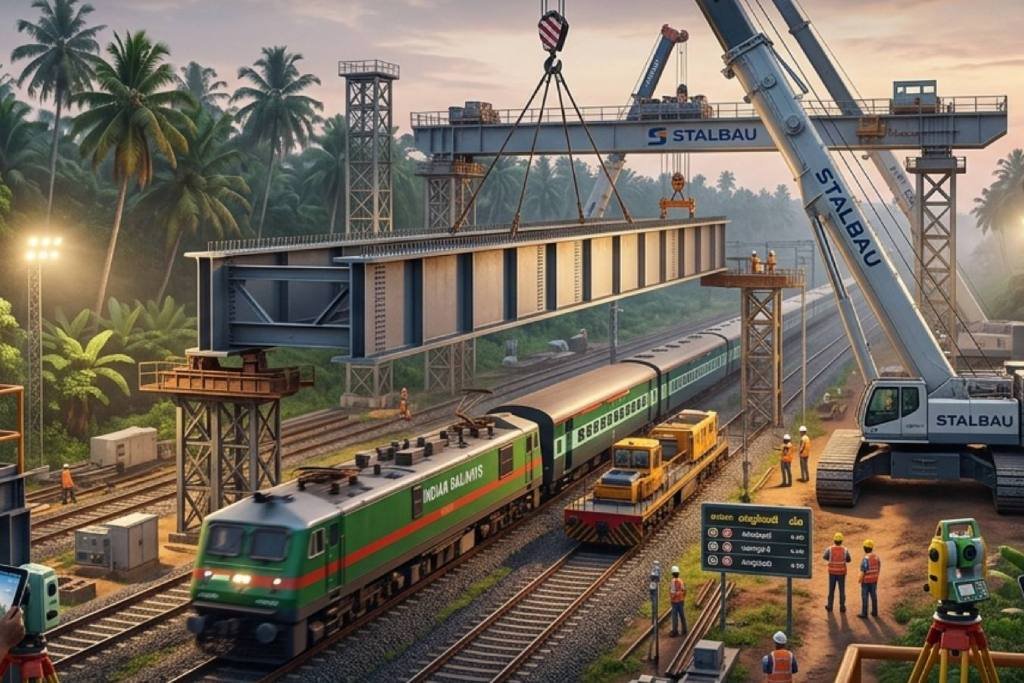
Kerala’s rapid infrastructure expansion demands innovative structural solutions. From urban metro networks to high-speed rail bypasses and flyovers bridging congested coastal highways, bridge construction in the state faces a unique set of challenges: tight right-of-way (ROW), monsoon-driven schedules, soft coastal soils, and above all, working directly over active Southern Railway tracks.
When erecting heavy steel box girders across live rail corridors, standard construction methodologies fall short. A single delayed block hour can cascade into regional transit disruptions. At Stalbau, optimizing heavy box girder installation isn’t just about crane capacity—it is a discipline combining precise engineering design, meticulous logistics planning, and flawless execution.
The Challenges of Rail-Corridor Erection in Kerala
Executing heavy lifting projects over active railways in Kerala presents a complex mix of technical and site-specific hurdles:
-
Strict Power & Traffic Blocks: Southern Railway typically grants limited operational window slots (often restricted to 2 to 4 hours during off-peak night hours). All lifting, alignment, and temporary securing must occur within this tight timeframe.
-
Tight Spatial Footprints: Dense urbanization across Kerala leaves minimal ground space for staging ultra-heavy crawler cranes or assembling multi-ton steel girder segments.
-
Monsoon & Environmental Factors: Heavy tropical rainfall and unstable soil conditions demand specialized ground support systems to handle massive outrigger loads safely.
Core Engineering Strategies for Seamless Erection
To minimize track occupation time and ensure absolute site safety, modern bridge engineering relies on four core technical strategies:
1. Off-Site Pre-Assembly & Trial Assembly
To eliminate on-site fit-up delays, steel box girders should be fabricated, trial-assembled, and QA/QC-checked at dedicated fabrication facilities prior to transport. Delivering ready-to-hoist segment assemblies reduces night-block operations to simple lifting, positioning, and immediate bolting/welding.
2. Advanced Erection Methodologies
Selecting the optimal launch method depends directly on site geometry, crane access, and track layout:
| Method | Best Suited For | Key Advantage |
| Tandem Heavy Crane Lifting | Open access areas with firm staging ground | Fast execution during short block windows |
| Incremental Launching (ILM) | Multiple spans over dense multi-track lines | Eliminates the need for heavy cranes over active tracks |
| Gantry / Portal Crane Systems | Restricted side clearances (e.g., urban metro corridors) | High vertical control within narrow rights-of-way |
3. Digital Twin & 3D Lift Simulations
Utilizing BIM and 3D lift simulations allows engineering teams to map out crane tail-swing radiuses, boom clearances against overhead catenary lines (OHE), and temporary shoring placements long before equipment arrives on site.
4. Rapid Load Transfer & Temporary Locking Mechanisms
Custom-designed quick-connect guide pins, hydraulic alignment jacks, and pre-engineered temporary bracing ensure that the structural segment is self-supporting before the rail block time expires and trains resume movement underneath.
Building Kerala’s Future Infrastructure Safely
Optimizing box girder erection over live transport corridors requires blending high-strength steel design with sophisticated project controls. By combining advanced pre-engineering, precision rigging, and stringent safety protocols, complex infrastructure can be delivered on schedule—keeping Kerala connected on both road and rail.
Partner with Stalbau for advanced structural steel fabrication, heavy bridging solutions, and specialized erection engineering tailored for high-density corridors.