In commercial and industrial construction, choosing between Pre-Engineered Steel Buildings (PEB) and traditional Reinforced Cement Concrete (RCC) often dictates the overall project timeline and budget. While concrete remains the traditional go-to for residential structures, PEB has rapidly become the preferred choice for industrial facilities, modern office spaces, and large-span commercial developments.
Here is a breakdown of how PEB and concrete compare across structural performance, cost efficiency, and construction speed.
Core Operational Differences
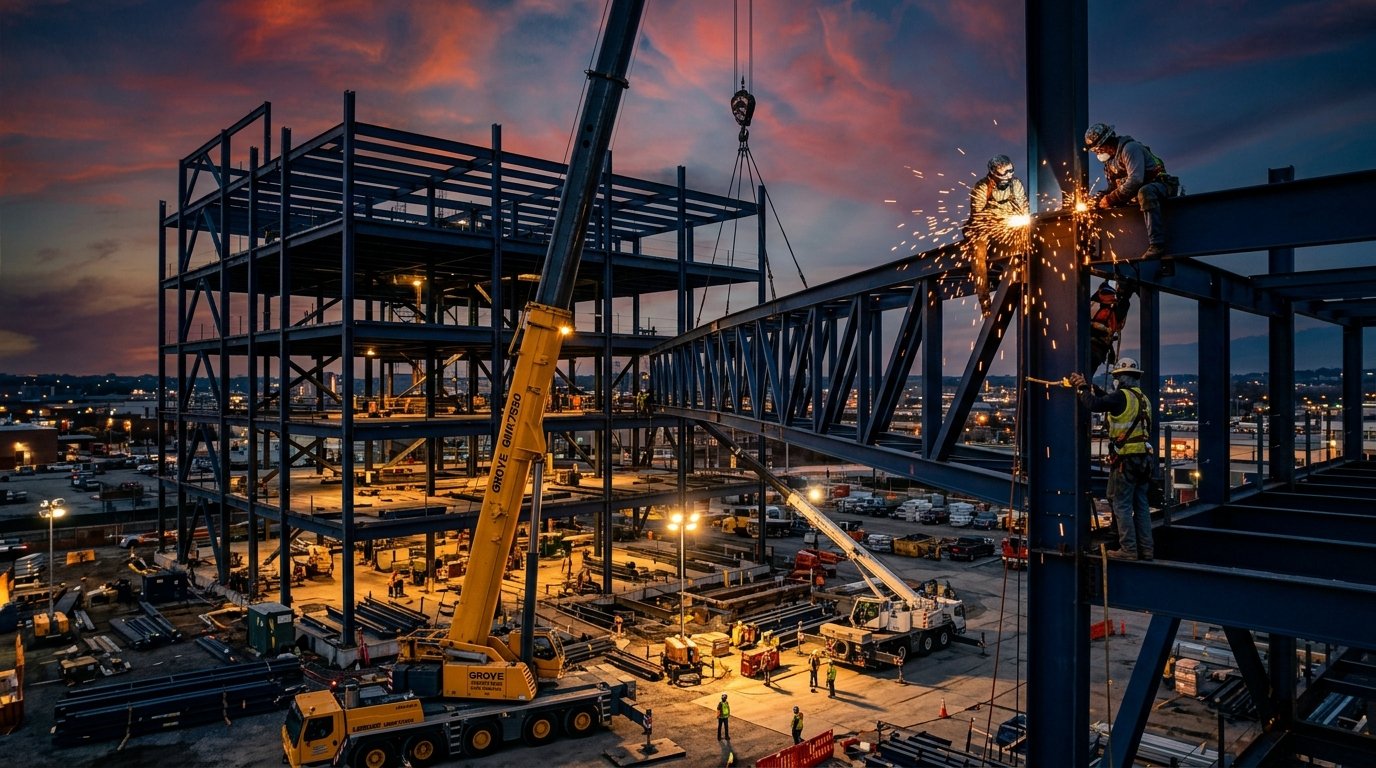
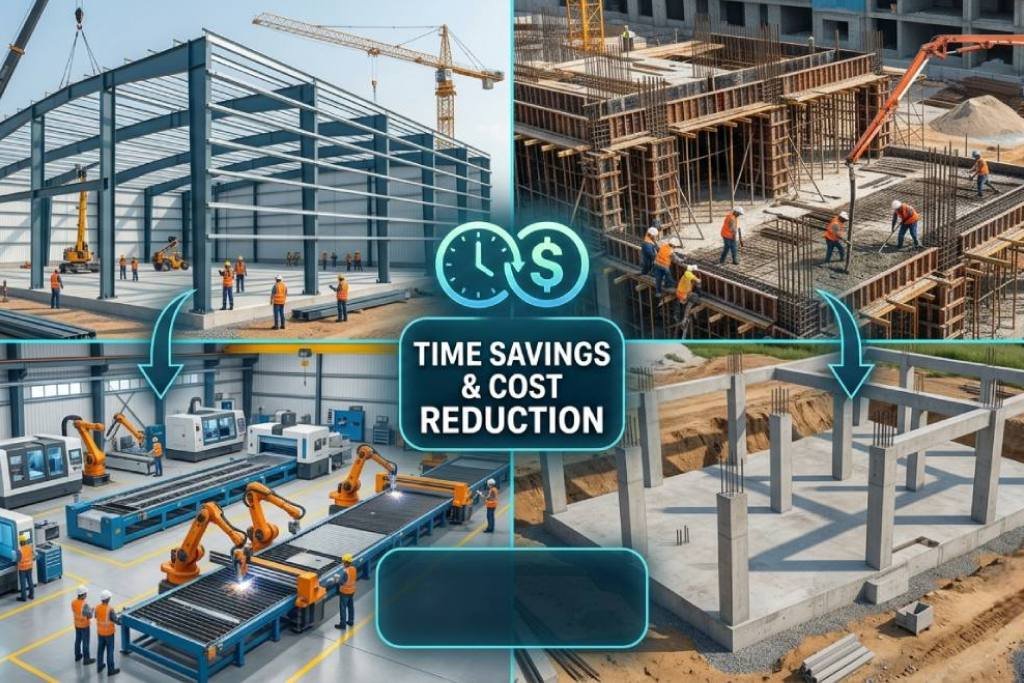
PEB systems rely on off-site factory fabrication where steel members are precision-engineered and then shipped to the site for bolt assembly. In contrast, RCC construction is an on-site, labor-intensive process involving formwork, rebar tying, wet concrete pouring, and extended curing periods.
       PRE-ENGINEERED BUILDINGS (PEB)                  REINFORCED CONCRETE (RCC)
┌──────────────────────────────────────────┐    ┌──────────────────────────────────────────┐
│  Factory Fabrication  ➜  On-Site Assembly│    │  On-Site Formwork  ➜  Wet Pour & Curing  │
│  • Rapid bolt connection                 │    │  • Labor-intensive rebar tying           │
│  • Off-site quality control              │    │  • Weather-dependent curing periods      │
│  • Lightweight & wide clear spans        │    │  • Heavy self-weight & thick columns     │
└──────────────────────────────────────────┘    └──────────────────────────────────────────┘
Direct Comparison
| Parameter | Pre-Engineered Steel Buildings (PEB) | Reinforced Concrete (RCC) |
| Construction Speed | 30%–50% faster; components arrive ready for assembly | Slower; dependent on formwork setup and curing cycles (21–28 days per lift) |
| Foundation Requirements | Lighter foundations due to high strength-to-weight ratio | Heavier, deeper foundations to support massive dead loads |
| Clear Span Capabilities | Uninterrupted spans up to 60m+ without intermediate columns | Limited column-free spans; requires dense column grids |
| Labor Dependency | Low on-site labor; requires a skilled erection crew | High on-site labor; heavily dependent on manual labor availability |
| Material Wastage | Minimal (< 2%); factory cutting and punching precision | Moderate to high; on-site cutting, shuttering, and concrete spills |
| Expansion & Flexibility | Highly modular; easily expandable or relocated | Rigid; structural modification requires costly demolition |
Where Steel Delivers Measurable Savings
1. Accelerated Return on Investment (ROI)
Time directly impacts financial returns in commercial construction. Because PEB components are fabricated off-site while foundation work occurs simultaneously, project schedules are routinely compressed by 30% to 50%. Early completion allows warehouses, factories, and retail spaces to start generating revenue months ahead of an equivalent RCC build.
2. Foundation and Material Efficiency
Steel possesses a significantly higher strength-to-weight ratio than concrete. A lighter superstructure reduces the total dead load transmitted to the ground, translating directly to:
-
Smaller footings and reduced excavation costs.
-
Lower material consumption in poor soil conditions.
-
Reduced site preparation time.
3. Maximize Usable Floor Space
Concrete columns must be thick to support heavy vertical and lateral loads, which reduces usable floor area. PEB structures utilize slender, high-strength tapered steel frames that maximize clear-span floor space—critical for logistics hubs, manufacturing plants, and auditoriums requiring unhindered equipment movement.
4. Reduced On-Site Financing & Overhead Costs
Shorter construction schedules minimize recurring project overheads, such as:
-
Equipment rental (cranes, scaffolding, generators).
-
Site supervision and security costs.
-
Interest accrued on construction loans during the build phase.
Ideal Use Cases
                                  WHEN TO USE WHICH
                                          │
                   ┌──────────────────────┴──────────────────────┐
                   ▼                                             ▼
         PRE-ENGINEERED BUILDINGS                        REINFORCED CONCRETE
    • Warehouses & Logistics Hubs                   • Multi-story Residential
    • Factories & Industrial Plants                 • Underground Structures & Basements
    • Aircraft Hangars & Depots                     • Retaining Walls & Dams
    • Retail Big-Boxes & Showrooms                  • Low-Rise Modular Housing
Summary Verdict
While concrete remains suitable for heavy sub-grade structures and multi-story residential developments, PEB is the superior choice for speed, cost predictability, and spatial efficiency in industrial and commercial sectors. By shifting structural fabrication from the field to a controlled factory environment, PEB eliminates weather delays, reduces labor risks, and delivers a faster path to commercial operation.