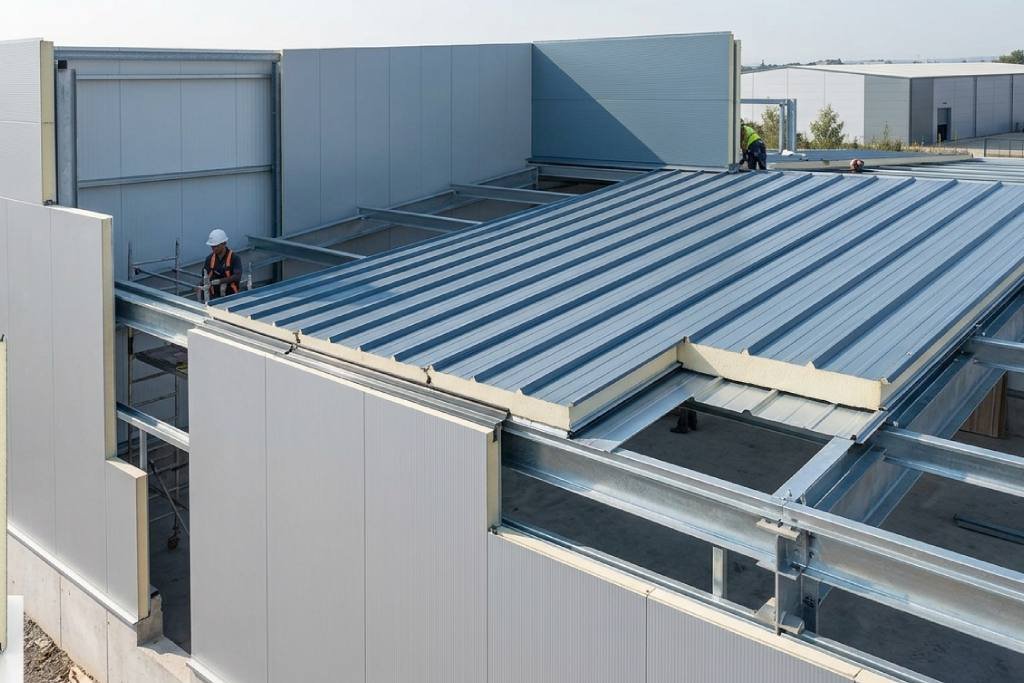
In modern commercial, industrial, and cold-chain construction, thermal insulation and rapid deployment are top priorities. Traditional walling and roofing methods—such as brickwork, concrete blocks, or uninsulated metal sheeting—often lead to high energy costs, long construction timelines, and significant weight loads.
Enter PUF (Polyurethane Foam) Sandwich Panels. These factory-engineered composite panels have become the preferred standard for roofs and walls across warehouses, cold storage units, commercial complexes, and cleanrooms.
Here is a comprehensive look at how PUF sandwich panels work, their core benefits, key applications, and why they are transforming modern building design.
What is a PUF Sandwich Panel?
A PUF sandwich panel consists of a rigid, high-density Polyurethane Foam (PUF) core sandwiched between two protective metal facings (typically pre-painted galvanized steel, aluminum, or stainless steel).
                      PUF PANEL CROSS-SECTION
┌─────────────────────────────────────────────────────────────────┐
│ Outer Metal Sheet (PPGL / PPGI / Aluminum) - Weatherproof      │
├─────────────────────────────────────────────────────────────────┤
│                                                                 │
│ Rigid Polyurethane Foam (PUF) Core - Thermal & Acoustic Barrier│
│                                                                 │
├─────────────────────────────────────────────────────────────────┤
│ Inner Metal Sheet (PPGL / PPGI / Stainless Steel) - Interior   │
└─────────────────────────────────────────────────────────────────┘
The layers are bonded under high pressure in a factory setting, creating a lightweight, highly structural composite panel that serves as both cladding and insulation in a single installation step.
Key Advantages of PUF Panels
| Parameter | PUF Sandwich Panels | Traditional Brick/Concrete Walls & Sheet Roofs |
| Thermal Conductivity | Extremely low (~0.022 W/mK); superior insulation | High thermal transfer; requires extra insulation layers |
| Construction Speed | 60%–70% faster; pre-fabricated modular tongue-and-groove fit | Slow; heavily dependent on wet work, curing, and multi-step labor |
| Structural Weight | Very lightweight (~10–15 kg/m² depending on thickness) | Heavy dead loads requiring deeper foundations |
| Energy Savings | Up to 40% lower HVAC/refrigeration power consumption | Higher energy bills due to heat gain/loss through walls & roof |
| Water & Vapor Resistance | 100% closed-cell structure; impervious to moisture | Porous; susceptible to dampness, seepage, and mold |
| Maintenance & Longevity | High weather resistance, corrosion protection, low maintenance | Requires regular painting, waterproofing, and crack repairs |
Roof vs. Wall PUF Panels: Key Differences
While both panel types share the same core insulation material, their structural profiles differ based on functional requirements:
1. PUF Roofing Panels
-
Trapezoidal Corrugation: Roof panels feature deep outer ribs/corrugation to maximize load-bearing strength (for wind, rain, snow, and maintenance access).
-
Overlapping Joints: Engineered with specialized weather-tight overlap joints to prevent water leakage during heavy downpours.
-
Gutters & Accessories: Integrated with matching ridge caps, flashing, and gutter systems for seamless rain runoff.
2. PUF Wall & Cladding Panels
-
Flat or Micro-Ribbed Finish: Designed with smooth, micro-ribbed, or architectural profiles for clean visual aesthetics.
-
Tongue-and-Groove Joints: Uses interlocking tongue-and-groove or hidden-fastener joints for airtight seal integrity and a flush surface finish.
-
Acoustic & Fire Performance: Available in varying densities and thicknesses depending on interior comfort and safety specs.
Core Operational Benefits
1. Dramatic Energy Cost Reduction
Polyurethane foam features one of the best thermal resistance values (R-value) per inch among commercially available insulation materials. By minimizing thermal bridging, PUF panels drastically reduce indoor heat ingress in summer and heat loss in winter, lowering operational costs for air-conditioned and cold-room environments.
2. Rapid Installation & Modular Flexibility
Because panels arrive on-site pre-cut and ready for assembly, large roof and wall areas can be installed in a fraction of the time needed for masonry. Furthermore, PUF structures are modular—they can easily be dismantled, expanded, or relocated without major structural damage.
3. All-Weather Leak Protection & Durability
The high closed-cell count (>95%) of rigid PUF prevents moisture absorption. Combined with tight inter-panel joints and high-grade metal coatings (like Galvalume or PPGI), PUF panels offer high resistance to corrosion, UV exposure, and environmental wear.
Primary Applications
                              WHERE PUF PANELS ARE USED
                                          │
    ┌───────────────────────┬─────────────┴─────────────┬───────────────────────┐
    ▼                       ▼                           ▼                       ▼
COLD STORAGE & FOOD   WAREHOUSES & LOGISTICS     CLEANROOMS & PHARMA     COMMERCIAL BUILDINGS
  • Chillers & freezers  • Wide-span roofing        • Dust-free enclosures  • Site offices
  • Meat & dairy plants  • Exterior wall cladding   • Controlled atmospheres• Prefab shelters
Summary Verdict
Whether constructing a temperature-controlled cold room, an industrial warehouse, or a modern commercial site office, PUF sandwich panels provide an all-in-one solution for insulation, speed, and structural protection. By replacing multi-layered traditional construction with single-component modular panels, builders achieve significant savings in both initial construction time and long-term operating energy expenses.